The Quick Answer First
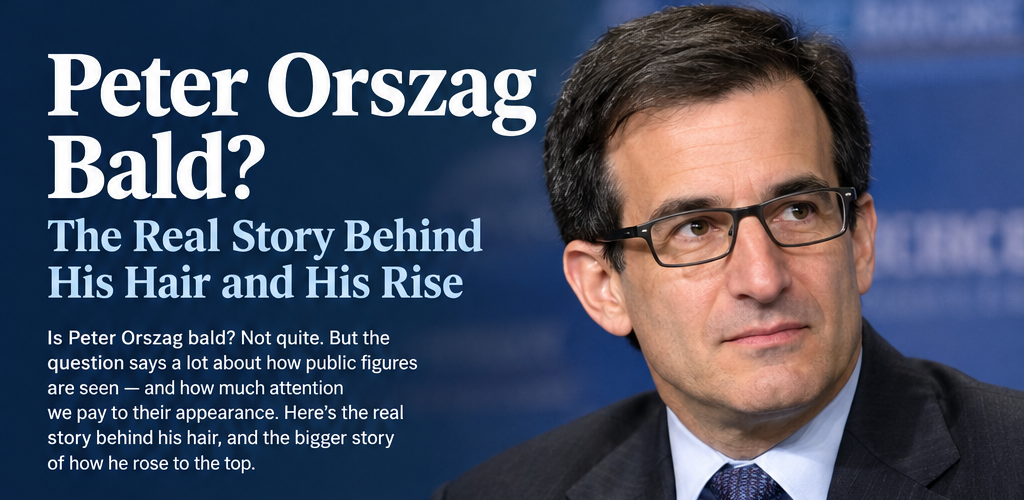
No, Peter Orszag is not bald. Look at any recent photo of him from his time leading Lazard and you will see a full covering of short, silver-gray hair, combed neatly and trimmed close at the sides. It is a tidy, no-fuss executive cut, the kind you would expect from a man who spends his days in boardrooms.
So why does the search “Peter Orszag bald” keep popping up? Because people notice things. Someone sees an old photo, then a new one, and thinks, “Wait, did his hair change?” Then they type the question into Google. This article walks through what is really known, what is just chatter, and why his career deserves more attention than his haircut.
How a Budget Expert Became a Hair Topic
Most economists never have to think about their looks. Orszag’s situation was different, because of where his career took him. He spent years in front of cameras and microphones, explaining government spending to the public at a time when the economy was in serious trouble. When you are on television that often, people study you closely.
Add the internet to that. A person who has been visible for nearly two decades leaves behind a huge trail of pictures. Anyone can line up a photo from 2007 against one from 2025 in seconds. Nearly everyone looks different across eighteen years. Faces get older, hair changes color, and styles come and go. When the person is a well-known public figure, those small changes become something strangers feel free to discuss.
There is one more reason. People tend to joke about the appearance of anyone who seems very serious or very smart. A budget director with a famous brain and a plain suit makes an easy target for casual curiosity. That is human nature, and it says more about the audience than about him.
Reading His Hair Honestly
Here is what the public record shows. In his younger government years, his hair looked darker. In recent years, it looks mostly gray. The cut has stayed short and conservative throughout, which is common among senior bankers and officials.
What a photo cannot tell you is how thick or thin his hair is. Think about how often a picture of yourself looks different depending on the light. Under bright overhead lights, scalp can show through even on someone with plenty of hair. Under soft light, the same head can look full. Gray and silver hair also reflects light in a way that can make it seem lighter in volume than dark hair, even when the amount is exactly the same. So when someone says “his hair looks thinner here,” they may simply be looking at a camera trick.
It matters, too, that Orszag has not publicly discussed his hair. There is no interview, no social media post and no on-the-record comment that I could find. Anything beyond what is visible in photos is opinion.
Turning Gray Is Not the Same as Thinning
Many people treat these two things as one. They are not. Hair turns gray when the cells that give it color slow down and eventually stop. Hair thins when follicles shrink or stop producing strong strands, a process described in more detail by the American Academy of Dermatology. One is about pigment. The other is about growth.
You can have either one without the other. Plenty of people in their sixties have a thick, bright white head of hair. Plenty of people in their twenties lose hair while it is still jet black. It is true that both tend to appear as we age, and that is why they get mixed up, but spotting gray does not mean you are seeing hair loss.
It is also worth remembering how common some change in the hairline is for men as they get older. If Orszag has noticed any change at all, he is far from alone, and there would be nothing odd or embarrassing about it.
Sorting Out the Wig Talk
Some websites like to suggest that Orszag wears a wig or a hairpiece. Let me be clear about what I found: nothing solid. There is no news report, no interview and no statement that backs it up. What exists are blog posts and forum comments, mostly built on one idea: “his hair looks too neat.”
If you read enough of these pages, a pattern shows up. One writer makes a guess. Another writer repeats it, dropping the word “maybe.” Soon a third site writes it as if it is settled. This is how rumors grow legs. It can feel like ten sources agree, when really it is one guess copied ten times. A few of these sites say the chatter began around 2010, when he was running the White House budget office, but none of them points to an original source I could check.
It also helps to know the vocabulary. A toupee is a small piece meant to cover a limited area, while a wig covers the whole head. Modern versions of both can look very real. And here is the catch: well-groomed natural hair can also look “too perfect” in a formal portrait. That is why you cannot prove either claim by staring at a photo.
And the Hair Transplant Question
Hair transplants come up for the same reason. In a transplant, a surgeon moves hair from one area of the scalp, usually the back, to a thinner area. It is a well-known choice for people who want fuller coverage. But no reliable report links Orszag to one.
The argument people make goes like this: “His hair looks fuller in this picture than in that one, so he must have had work done.” That is a big leap. A different haircut, a new part, a little styling product, a windy day or even a better camera lens can change how full hair looks. Jumping from “looks different” to “had surgery” skips every normal explanation.
Why Fairness Matters Here
When a story is about someone’s body or health, a bit of care goes a long way. Hair changes can have many causes, and some of them are private. If a person has not chosen to talk about it, writing as if you know the answer is not fair, even when that person is famous.
None of this means you should feel silly for being curious. Wondering is normal. The line gets crossed when a question is repeated so often that people start treating it as a fact. A simple habit helps: whenever you read a claim, ask who said it first. If nobody can show you, it is a rumor.
The Man Behind the Searches
Since so many pages about this topic say little about the person, let’s fix that. Peter Richard Orszag was born in Boston on December 16, 1968, so he is 57 today. Peter Richard Orszag grew up in Lexington, Massachusetts, in a family that valued numbers. His father, Steven, taught mathematics, and his mother, Reba, was involved in a research company. His brother, Jonathan, also works in economics.
For school, he attended Phillips Exeter Academy and then earned an economics degree at Princeton in 1991. A Marshall Scholarship then sent him to the London School of Economics, where he completed a master’s in 1992 and a doctorate in 1997. His research paper dealt with how economies behave during sudden shifts, using hyperinflation and privatization as test cases.
Early Years in Washington
Orszag first worked in government under President Clinton, serving as an economist and adviser on the Council of Economic Advisers and later as a special assistant to the president on economic policy. When that chapter ended, he built his own consulting business, which was acquired by FTI Consulting in 2005 for a reported 70 million dollars.
He then spent time at the Brookings Institution, one of Washington’s best-known research groups. There he helped launch the Hamilton Project in 2006, a project aimed at spreading practical economic ideas to a wider audience.
Counting the Costs at the CBO
In January 2007, he took charge of the Congressional Budget Office. Think of it as the government’s official calculator: when Congress debates a bill, this office tells lawmakers what it is likely to cost, and it does so without picking a side. Orszag expanded its health care staff to fifty full-time analysts, a smart bet considering how much of the national debate soon turned to medical spending. Many observers later said the office was better prepared because of it.
The Obama Years
After Barack Obama won the 2008 election, he asked Orszag to lead the Office of Management and Budget. Orszag served from January 2009 to July 2010. Those were tense, busy months. The country was climbing out of a deep recession, deficits were growing, and a fierce argument over health care reform filled the news.
As the person in charge of the federal budget, Orszag stood near the center of all of it. He was good at explaining complicated numbers in plain language, and that made him a regular guest on news shows. It was during this stretch that his face became familiar to millions, which is also when people began paying attention to how he looked.
From Washington to Wall Street
In 2011, Orszag joined Citigroup in a senior investment banking role. Then in 2016 he moved to Lazard, where he worked on deals and healthcare advisory. His rise there was steady. In 2019, he took over its financial advisory division, and in 2022 he created a team focused on geopolitical risk for clients.
He became chief executive on October 1, 2023. Early on, he set a bold goal of doubling the firm’s revenue by 2030, and he has pushed to bring in more senior dealmakers and grow areas like private credit. In January 2025, he added the chairman title. Within his first two quarters as CEO, the firm earned close to one billion dollars in deal fees.
Family and Other Roles
Orszag married journalist Bianna Golodryga in 2010, when she was working at ABC News. The couple has two children. He has other children from earlier in his life, and public records list five in total. Outside of Lazard, he belongs to the National Academy of Medicine and serves on the boards of the Peterson Institute for International Economics and Mount Sinai Hospital in New York.
Read More: Classroom 15x: What It Is, How It Works, and Is It Safe?
The Final Word
Here is where things stand. Orszag is not bald. He has short, mostly gray hair, and it was darker when he was younger. Nothing credible shows that he wears a wig or hairpiece, has had a transplant, or is dealing with any particular hair condition. Those ideas live online as guesses, not as reported facts.
The things we do know are far more interesting. He is a Princeton and London School of Economics graduate, a Marshall Scholar, a former head of both the Congressional Budget Office and the White House budget office, and now the leader of Lazard. That is a story worth reading, and it is a lot more solid than a rumor built on a photograph.
Quick Answers
Is Peter Orszag bald? No. Recent photos show short, gray hair.
Does he wear a wig? No reliable source says so. It is internet speculation.
Did he have a hair transplant? There is no credible report of one.
How old is he? He was born on December 16, 1968, so he is 57.
What is his job now? He is CEO and chairman of Lazard.