If you have ever sat in a corporate office, a school staff room, or a busy airport lounge, you have probably seen a Dell Latitude without noticing it. It is the plain, sturdy laptop that never makes a fuss. does not have the flashy looks of a gaming machine or the style of a thin consumer laptop. It just works, day after day. That quiet reliability is why the Dell Latitude has stayed popular with businesses for around thirty years.
This guide explains what the Dell Latitude is, how the different series compare, which features matter, and who should buy one. It also covers something many articles skip: Dell has changed the name of its business laptops, and that affects how you shop today.
What Is the Dell Latitude?
The Dell Latitude is a line of business laptops. Dell built it for people who use their computers for real work, such as writing reports, joining video calls, handling spreadsheets, and managing company data. Companies, schools, and government offices buy these laptops in large numbers because they are tough, secure, and easy for IT teams to manage.
Home laptops often focus on looks or price. Dell designed the Latitude around the daily life of a working professional. Its keyboard feels comfortable during long typing sessions, its battery lasts through meetings and travel, and Dell builds the security tools in from the start.. Over the years, the range has grown from simple office notebooks into a full family that includes thin ultraportables, 2-in-1s, detachable tablets, and rugged machines.
An Important Update: Latitude Is Now Dell Pro
There is one thing every buyer should know. At CES in January 2025, Dell announced that it was retiring several famous names, including Latitude, XPS, Inspiron, and Precision. In their place came three simple names: Dell, Dell Pro, and Dell Pro Max.
For business buyers, Dell Pro takes over from Latitude, while Dell Pro Max replaces the Precision workstation line. Each line now comes in Base, Plus, and Premium levels. Dell says this makes choosing easier, although some tech writers found the new names confusing.
In real life, this means Latitude laptops did not vanish. Millions are still in use, and many are sold through resellers and certified refurbished stores. Dell’s own website now sends Latitude shoppers to its Dell Pro section. So when you search for “Dell Latitude” today, you will see both older Latitude models and newer Dell Pro models that carry on the same idea.
How the Latitude Range Is Organized
Latitude models were grouped by number, and the number told you roughly where the laptop sat in price and features.
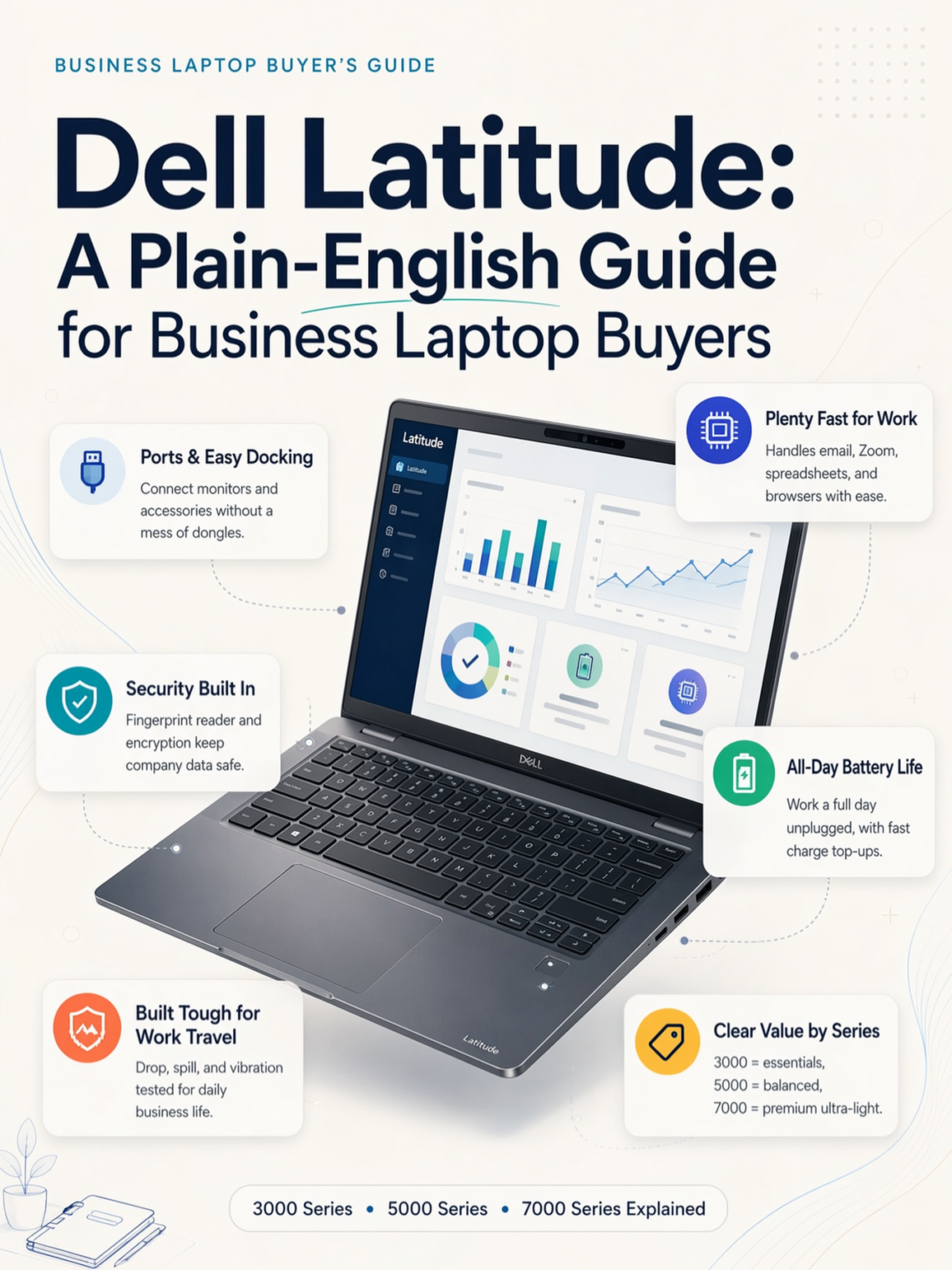
The Latitude 3000 series is the entry point. These are affordable laptops for everyday tasks like email, documents, and video calls, and they suit small businesses and schools that need to equip many people on a budget. The Latitude 5000 series is the mainstream choice and the one most companies buy. It comes in 13-inch, 14-inch, and 15-inch sizes, plus a 2-in-1, and it balances cost, security, and quality well.
The Latitude 7000 series moves into premium territory. These laptops are lighter and better suited to people who travel often. The 7350 Ultralight weighs just 0.98 kg, and the 7450 Ultralight weighs 1.05 kg, so both are easy to carry all day. The Latitude 9000 series sits at the top. The Latitude 9450 2-in-1, for example, was aimed at executives and consultants, and Dell described it as the smallest 14-inch commercial PC in the world.
There were also rugged models, which now continue under the Dell Pro Rugged range. These are built for field engineers, emergency crews, and anyone working around dust, water, and shocks.
Design and Build Quality
People trust the Latitude partly because of how Dell builds it. Many models use strong materials like aluminum and carbon fiber, and Dell tests many of them to military-grade durability standards. That does not make them indestructible, but they cope far better with a rough commute than an ordinary laptop.
Comfort matters too. Latitude laptops usually have well-spaced keys, smooth touchpads, and screens with thin borders. Some offer touchscreens and eye-comfort technology that reduces harsh blue light. Different shapes are available as well. A 2-in-1 folds into a tablet for taking notes, and the Latitude 7350 Detachable works as a light tablet with an optional detachable keyboard and pen, then turns into a full laptop when docked at a desk.
Performance and the Rise of AI
Latitude laptops come with Intel Core processors and, in some models, AMD Ryzen processors. You can usually choose the memory and storage you want, so heavy users can get more power while light users save money.
The newest generation uses Intel Core Ultra processors, which include a part called an NPU. Think of it as a small helper that handles AI tasks, such as blurring your background or keeping your face centered on a video call, so the main processor does not have to. According to Dell, this can give workers up to 38 percent more battery life during a day full of Zoom calls, based on Intel testing, so real results will vary. Many models also support fast connections like Wi-Fi 6E, 5G options, and Thunderbolt ports.
Security: Why Companies Choose Latitude
Security is where the Latitude earns its place in business. Many models offer fingerprint readers and face login through Windows Hello, and some support smart card and NFC login. A TPM 2.0 chip keeps encryption keys safe inside the laptop, which helps protect data if the device is lost or stolen.
Dell also protects the deeper layers. SafeBIOS helps guard the startup software, and some models include SafeScreen to stop people from peeking at your screen. Dell added a feature that scans for known security weaknesses and advises IT teams on fixing them. For IT teams, tools like Dell Command Update and support for Microsoft Endpoint Manager and VMware Workspace ONE make it possible to manage hundreds of laptops from one place. Dell calls its commercial PCs the industry’s most secure, though that is Dell’s own claim.
Battery Life and Remote Work
Nobody wants to hunt for a power socket in the middle of a meeting. Dell Optimizer learns how you use your laptop and adjusts battery use and performance to match, while fast charging and USB-C charging make top-ups quick. On the Latitude 9450, Dell says the mini-LED keyboard backlight can cut keyboard power use by up to 75 percent.
These laptops also suit hybrid work. Recent models have good webcams, some with HDR for clear pictures in tricky light, plus AI noise reduction that removes background sounds. The collaboration touchpad puts Microsoft Teams and Zoom controls right under your fingers, and ExpressConnect helps pick the strongest Wi-Fi so calls drop less often.
Sustainability and Repairs
Dell has worked to reduce the environmental impact of these laptops. The Latitude 7350 Detachable uses a chassis made from 90 percent recycled magnesium and a kickstand made from 75 percent recycled aluminum, according to Dell’s own figures. It also has removable batteries and displays, and upgradeable storage, which makes repairs quicker and cheaper. Dell also runs recycling programs for old devices.
How Latitude Compares With Other Dell Laptops
Dell aimed XPS at consumers who wanted premium looks, offered Inspiron as the budget choice for home and school, and built Precision as the workstation line for heavy work like 3D design.. Latitude sat in the middle as the secure, well-supported business choice. After the rebrand, Dell Pro carries on the Latitude job, Dell Pro Max carries on the Precision job, and the plain Dell name covers everyday home and school laptops.
Who Should Buy One, and What to Check First
A Latitude or Dell Pro suits anyone who values reliability over flash, including office workers, managers, teachers, consultants, and IT buyers. It is especially good for companies that need many laptops with the same security and management tools. A casual user who only browses the web may be fine with a cheaper laptop, and gamers or video editors will do better with machines built for that work.
Before buying, think about how you work. If you travel a lot, look at lighter 7000 or 9000 class models. If you mostly work at a desk, the 5000 class gives plenty for less money. Choose enough memory, since it can be hard to upgrade later, and check the warranty and support options. If you are buying an older Latitude from a reseller, check the battery condition and the warranty, because a refurbished Latitude can be excellent value.
Read More: Brooke daniells
Final Thoughts
The Dell Latitude earned its reputation by doing the basics very well: sturdy build, strong security, comfortable design, and dependable support. The name is being replaced by Dell Pro, but the idea behind it is alive and still useful. Whether you choose a trusted older Latitude or a newer Dell Pro, you are getting a laptop made for people who want to get work done without drama.