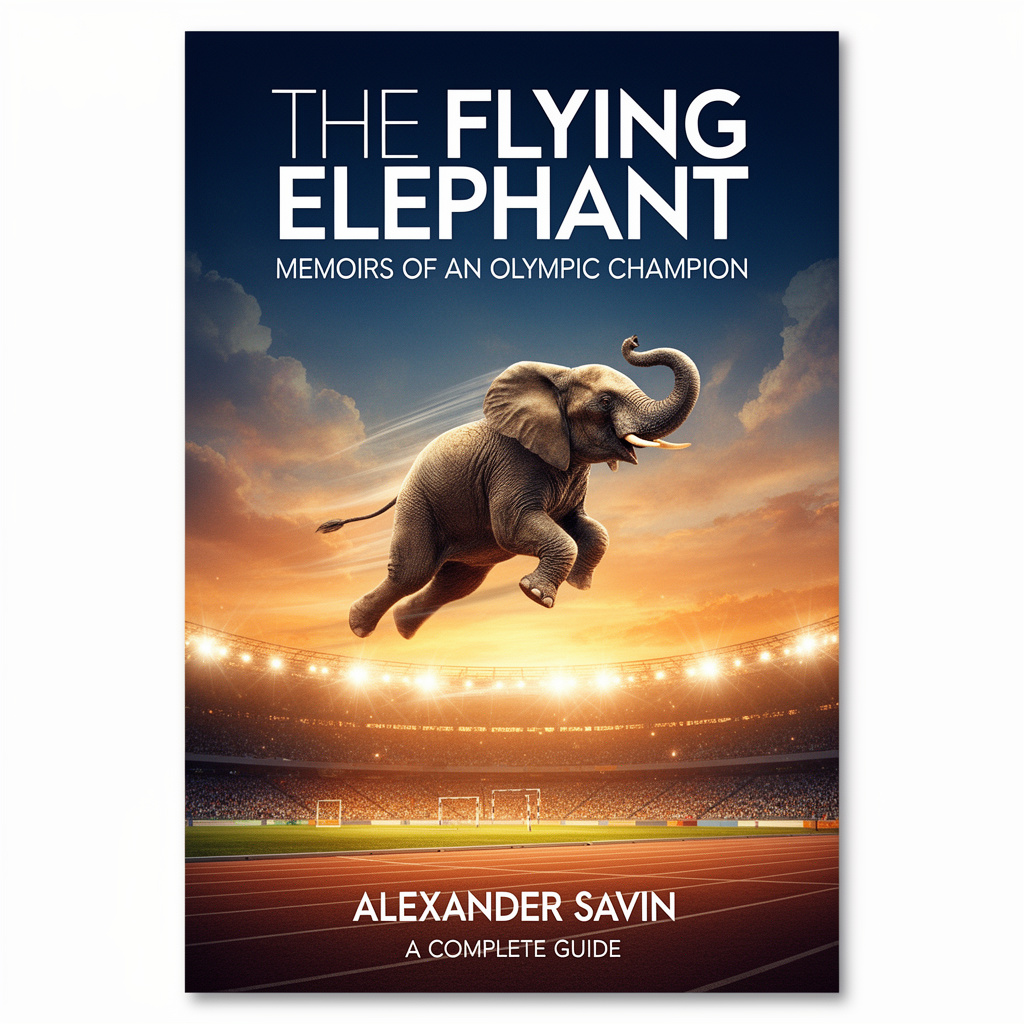
The Flying Elephant: Memoirs of an olympic champion kindle edition alexander savin: Some book titles make you stop and look twice. The Flying Elephant is one of them. It sounds like a picture book about a circus animal with wings. It is actually a sports memoir written by a real Olympic champion, and it tells the story of a man who played volleyball at the very top of the world during one of the most powerful eras the sport has ever had.
If you are searching for The Flying Elephant: Memoirs of an Olympic Champion Kindle edition by Alexander Savin, you probably want a few simple answers. Who is the author? What is the book about? Is the Kindle version worth buying? This guide covers all of that in plain language, and it is honest about what is known and what is not.
What Is The Flying Elephant: Memoirs of an Olympic Champion?
The Flying Elephant: Memoirs of an Olympic Champion is an English-language memoir attributed to Alexander Savin, a former Soviet volleyball star. It is sold as a Kindle eBook, which means you can read it on a Kindle device, a phone, a tablet or a computer using the free Kindle app.
The book focuses on Savin’s life in volleyball. That includes his rise through Soviet sport, his time on the national team, the Olympic Games he played in, and the people who shaped him along the way. It is a story about training, teamwork and pressure as much as it is about medals.
One thing to keep in mind is that this is not a famous bestseller with hundreds of professional reviews. It is a niche title. That is not a bad thing, but it does mean you should read the free sample before you buy.
Who Is Alexander Savin?
To understand the book, you need to know the man. His full name is Aleksandr Borisovich Savin. He was born on July 1, 1957, in Taganrog, a port city in southern Russia. Olympedia lists him at 200 centimeters tall, which is about six feet seven inches, and 97 kilograms. In volleyball, where the net is more than two meters high, that is the kind of size that helps a player block and attack at the net.
Savin played as a middle blocker. The middle blocker stands at the center of the net and tries to stop the other team’s attacks with a wall of hands and arms. It is a job that asks for good timing, quick feet and a lot of courage. According to Wikipedia, his first coach was Vladimir Pitanov. Later, he played for CSKA Moscow, the famous army sports club that produced many of the best Soviet athletes.
For the national team, Savin played from the mid-1970s until the mid-1980s. That is a long run at the top, and staying at that level for ten years takes real discipline.
An Olympic Career With Heartbreak and Glory
Savin’s Olympic story has two very different chapters, and together they make a great base for a memoir.
The first came at the 1976 Games in Montreal. The Soviet Union had ruled Olympic men’s volleyball since the sport first appeared in 1964, winning gold in both 1964 and 1968. Going into Montreal, they were big favorites. According to the International Volleyball Hall of Fame, Poland upset them in a close 3–2 match, and the Soviets went home with silver. Savin played in all five of his team’s matches.
Losing a gold medal match is painful for any athlete, especially when your team was expected to win. But the Hall of Fame notes that the loss made the team more determined, and the players started preparing for 1980 right away.
That next chance came on home ground. The 1980 Olympics were held in Moscow. A number of countries, including the United States, did not attend because of a political boycott, but the Soviet team still had to win in front of its own people. Savin played all six matches. The Soviets swept past Romania on the way, then beat Bulgaria 3–1 in the final to take the gold medal.
So Savin knows both sides of Olympic sport: the sting of finishing second and the joy of winning at home. A memoir that covers both has the potential to be honest and moving.
More Than Olympic Medals
Savin’s list of achievements goes far beyond the Olympics. His team won the FIVB World Cup in 1977 and again in 1981. They won the World Championship in 1978 and 1982, and took silver in 1986. He also won European titles, including the 1977 and 1979 championships, according to the Hall of Fame. In 1980, he was awarded the Order of the Badge of Honour in the Soviet Union.
In October 2010, Savin was inducted into the International Volleyball Hall of Fame in Holyoke, Massachusetts. This matters for the book because it tells us the author is not just a good player with a good story. He is widely seen as one of the best middle blockers in the history of the game, so readers have good reason to take his account seriously.
Why Is the Book Called The Flying Elephant?
This is the question most readers ask first, so let me answer it honestly. Several websites say the title comes from a nickname given to Savin by teammates or fans. The idea is that he was a big, strong man who still moved quickly and jumped high, like an elephant that could fly.
That explanation makes sense, but I could not find a solid source, such as the book’s own text or an interview with Savin, that confirms exactly how the nickname started. Even the top-ranking pages on this topic use cautious words like “supposedly” and “apparently.” So treat the story as a likely explanation rather than a proven fact. The first chapters of the book, or the Kindle sample, are the best place to check.
What is clear is that the image works. An elephant is heavy and powerful, while flying is light and free. Put them together, and you get a good picture of what a top volleyball blocker does: leap high, hang in the air and bring real force down on the ball.
What Can Readers Expect From the Book?
I need to be careful here. I was not able to read the full text, and many websites that describe the book appear to be copying each other. Some of them make claims that are clearly wrong, such as saying Savin was a gymnast or that the book is about aerial navigation. Please ignore those. Savin was a volleyball player, and the book is a volleyball memoir.
Based on the author’s career, the book is likely to cover Savin’s early years, his time in the Soviet system, his years with CSKA Moscow and the national team, and his Olympic experiences in 1976 and 1980. Some descriptions also mention a large collection of old photographs, though I could not confirm the exact number, so check the listing for details.
A memoir like this works best when it goes beyond results. Anyone can look up scores. What readers want is the story behind them: what daily training felt like, how a coach pushed strong personalities toward one goal, and what it was like to lose a final and then come back four years later to win. Those details can only come from someone who lived it.
There is also a historical side. Not many English-language books come from players who were inside the Soviet sports system of the 1970s and 1980s, so a first-person account has real value, even if it is told from one person’s point of view.
The Kindle Edition: What to Know Before You Buy
The Kindle edition is the easiest way to read this book in English. You can get it right away without waiting for shipping, change the text size, search for names and teams, and carry the book everywhere on your phone.
There are a few simple things to check before you buy. First, download the free sample from Amazon to see if the writing style suits you. Second, look at the product details to see the page count and whether the book was translated from another language, since translated memoirs can sometimes lose a little of the author’s voice. Third, if the book has many photos, think about your device. Old photographs usually look better on a tablet or a larger screen than on a small phone.
Finally, read a handful of reviews, but think about what they say. A review that mentions specific chapters, matches or people tells you more than a vague one that could be about any sports book.
Who Should Read This Memoir?
Volleyball fans are the obvious audience. If you have ever watched a match and wondered what it takes to play at the top, a book from a player who stood at the net in two Olympic finals is a good place to start. Players and coaches may also enjoy the details about training and team life. Readers who love sports history will find a lot to like too, since the Soviet teams of Savin’s time were famous for their strength and discipline.
You do not need to be a sports fan, though. The best sports memoirs are really about human things: working hard for years, handling pressure, losing, getting back up and finding out who you are when the cheering stops. On the other hand, if you want a fast, flashy book packed with action from the first page, this may feel slower than you want.
Is The Flying Elephant Worth Reading?
If you care about volleyball, Olympic history or Soviet-era sport, yes, it looks like a worthwhile read. The author’s record is real and well documented, and few people are better qualified to write about this subject.
The honest caution is that there is limited independent information about the book itself. Many websites repeat the same few lines, and some add made-up details. That is why the Kindle sample is so useful. A few pages will tell you whether Savin’s voice is right for you.
Read More: Selcuksports
Final Thoughts
The Flying Elephant: Memoirs of an Olympic Champion is more than a fun title. It carries the story of Alexander Savin, a tall, quick middle blocker from Taganrog who went from losing the 1976 Olympic final to winning gold on home soil in 1980. His career includes world titles, European crowns and a Hall of Fame induction. If that sounds like a story you want to hear from the man himself, the Kindle edition is an easy way to read it. Check the sample, look at the product details, and go in with realistic expectations