In today’s digital world, people rely on dozens of apps every day. Businesses use project management software, communication tools, cloud storage, CRMs, email platforms, and productivity apps to get work done. While these tools are powerful, managing them separately often creates unnecessary work and confusion.
This is where apps and software AlienSync comes into the picture.
AlienSync is presented as a platform that helps connect different applications, automate repetitive tasks, and keep information synchronized across multiple software tools. Instead of manually moving data from one app to another, users can create connected workflows that save time and reduce errors.
This guide explains everything you need to know about apps and software AlienSync, including its features, benefits, possible limitations, practical use cases, and how it compares with similar integration platforms. Whether you are a freelancer, business owner, content creator, or remote team member, this article will help you understand whether AlienSync is the right solution for your workflow.
What Is Apps and Software AlienSync?
Apps and software AlienSync is described as a software integration and synchronization platform that connects different digital tools into one unified system. Rather than treating every application as a separate workspace, AlienSync allows information to move between them automatically.
For example, imagine receiving a new customer inquiry through your website. Instead of manually copying that customer’s information into your CRM, creating a project task, and notifying your team, AlienSync can automate the entire process.
The goal is simple: reduce repetitive work while keeping all connected applications updated with the latest information.
Why Software Integration Matters Today
Modern businesses rarely use a single software solution.
A typical company may use email software for communication, cloud storage for files, accounting software for finances, customer relationship management software for sales, marketing platforms for campaigns, and messaging apps for internal collaboration.
Without integration, employees spend valuable time copying information between systems. This increases the risk of mistakes, duplicate records, and outdated information.
Software synchronization solves these problems by allowing applications to exchange data automatically. Instead of working separately, every connected tool becomes part of one organized workflow.
That is the main idea behind AlienSync
Key Features of Apps and Software AlienSync
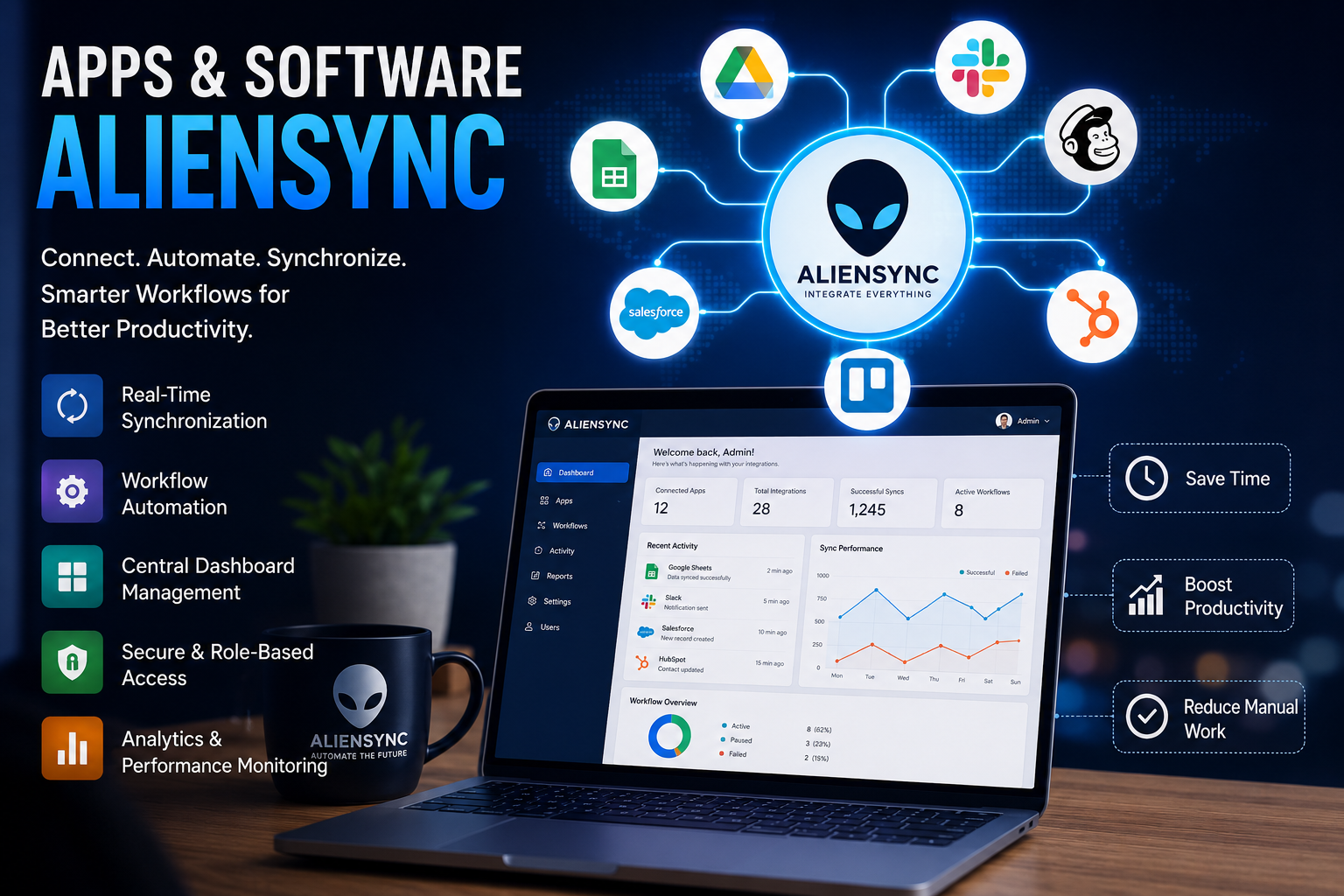
One of the reasons AlienSync attracts attention is its combination of automation and centralized management. Rather than simply connecting apps, it aims to provide greater visibility into how those connections work.
Real-Time Data Synchronization
Real-time synchronization means that when information changes in one connected application, the same update appears in other linked systems almost immediately.
This helps teams avoid outdated information and keeps everyone working with the latest data.
For businesses managing customer information, project updates, or inventory, this feature can significantly reduce manual work.
Central Dashboard
Instead of logging into several different applications throughout the day, users can monitor connected software from one dashboard.
The dashboard typically displays connected apps, synchronization status, recent activity, alerts, and workflow performance, making it easier to manage multiple integrations.
Workflow Automation
Automation is one of AlienSync’s strongest capabilities.
Users can create rules that trigger actions automatically whenever a specific event occurs.
For example, when a customer submits a contact form, AlienSync can create a CRM record, assign a sales representative, send a welcome email, and notify the team without requiring manual input.
Automation not only saves time but also ensures consistent business processes.
User Access Management
Organizations often need different permission levels for employees.
AlienSync supports role-based access controls, allowing administrators to decide who can edit integrations, manage workflows, or simply view reports.
This improves both security and organization for growing teams.
Analytics and Performance Monitoring
Managing integrations is easier when users can monitor performance.
AlienSync includes reporting features that help identify failed synchronizations, workflow activity, and overall system performance.
These insights allow businesses to improve efficiency over time.
API and Custom Integrations
Not every organization uses standard software.
AlienSync also supports API connections and webhooks, allowing developers to connect custom applications or build specialized workflows for unique business needs.
Benefits of Using Apps and Software AlienSync
Using multiple disconnected applications often creates unnecessary complexity.
AlienSync attempts to solve this by offering several practical advantages.
First, automation reduces repetitive manual work, allowing employees to focus on more valuable tasks.
Second, synchronized data improves accuracy because information stays consistent across different systems.
Third, centralized management saves time by reducing the need to switch between multiple dashboards throughout the day.
Another important benefit is improved collaboration. Since all connected software stays updated automatically, teams can make decisions using the same information instead of relying on outdated records.
Finally, businesses can scale more easily because automated workflows continue working even as the number of applications grows.
Who Should Use Apps and Software AlienSync?
AlienSync is not designed only for large companies.
It can be useful for several types of users depending on their workflow requirements.
Freelancers who manage multiple clients can connect communication tools, calendars, invoicing software, and project management platforms.
Small businesses can automate customer management, sales processes, and internal communication.
Marketing teams can synchronize CRM systems with email marketing platforms, analytics tools, and social media management software.
Remote teams benefit from shared information across collaboration platforms, reducing communication delays.
Software developers can also use AlienSync to connect custom applications through APIs and webhooks.
Common Business Use Cases
AlienSync becomes easier to understand when viewed through real-world examples.
A sales company may automatically create customer records after someone submits a website inquiry.
An online store could synchronize orders between its ecommerce platform, accounting software, and inventory management system.
Marketing agencies might connect social media scheduling tools with analytics platforms to monitor campaign performance more efficiently.
Human resources departments could automatically update employee records whenever new hires complete onboarding forms.
These practical applications demonstrate how automation removes repetitive administrative work while improving consistency.
Getting Started with AlienSync
Setting up AlienSync is generally a straightforward process.
Users first create an account and connect the software applications they want to integrate.
After authorizing those applications, they can begin building automation rules based on specific triggers.
Most users start with simple workflows before creating more advanced automation involving multiple applications.
Testing each workflow is an important step because it helps ensure that data moves correctly between connected systems before automation is used in daily operations.
Security and Data Protection
Whenever multiple applications exchange information, security becomes a major concern.
AlienSync emphasizes secure authentication methods and controlled user permissions to protect connected accounts.
Businesses should still follow general cybersecurity best practices.
Using strong passwords, enabling multi-factor authentication where available, limiting administrator access, and regularly reviewing connected applications all contribute to a more secure integration environment.
Organizations handling sensitive customer information should also ensure their workflows comply with applicable privacy regulations.
Potential Limitations
No software platform is perfect, and AlienSync also has some considerations.
The first is the learning curve.
Simple app connections are relatively easy to configure, but complex automation involving many conditions may require additional time to understand.
Pricing can also increase as businesses connect more applications or process larger amounts of synchronized data. Companies should evaluate their actual integration needs before selecting a plan.
Finally, organizations using highly customized enterprise software may need additional API development to build specialized integrations.
AlienSync vs Other Integration Platforms
Many users compare AlienSync with platforms such as Zapier, Make, and similar workflow automation tools.
AlienSync focuses on providing centralized management alongside automation, making it attractive for organizations that want both synchronization and visibility.
Zapier is often praised for its beginner-friendly interface and large library of supported applications.
Make offers advanced workflow customization but may require more technical knowledge.
The right choice depends on business requirements, budget, and the complexity of desired automations.
Companies that mainly need simple automation may prefer easier solutions, while organizations managing larger digital ecosystems may appreciate AlienSync’s broader synchronization capabilities.
Best Practices for Success
Organizations achieve better results when they plan integrations carefully.
Instead of connecting every available application immediately, it is usually better to begin with the software that causes the biggest workflow challenges.
Workflows should be given clear names so administrators can easily understand their purpose later.
Monitoring synchronization reports regularly helps identify errors before they affect business operations.
Businesses should also review integrations periodically and remove workflows that are no longer necessary.
A well-maintained automation system remains faster, cleaner, and easier to manage over time.
The Future of Software Integration
Software ecosystems continue becoming more connected each year.
Artificial intelligence, cloud computing, and workflow automation are making integrations smarter than ever before.
Future integration platforms will likely provide more predictive automation, better analytics, stronger security features, and easier no-code development.
AlienSync appears to be positioning itself within this growing trend by combining application synchronization, workflow automation, and centralized management into one platform.
As organizations continue adopting more digital tools, software integration will become less of a convenience and more of a necessity.
Final Thoughts
Apps and software AlienSync offers a practical approach to connecting today’s growing collection of business applications. Instead of forcing users to manually transfer information between platforms, it focuses on creating automated workflows that improve productivity, reduce repetitive tasks, and keep data synchronized across multiple systems.
For freelancers, startups, growing businesses, and larger organizations, the platform can simplify everyday operations by bringing different software tools together under one management system. Although users should expect a learning curve when building advanced automations, the long-term efficiency gains can make the investment worthwhile.
As businesses continue relying on increasingly complex digital ecosystems, platforms like AlienSync represent an important step toward smarter, faster, and more connected workflows. By understanding its capabilities, limitations, and best practices, you can determine whether AlienSync fits your organization’s automation strategy and future growth plans.