
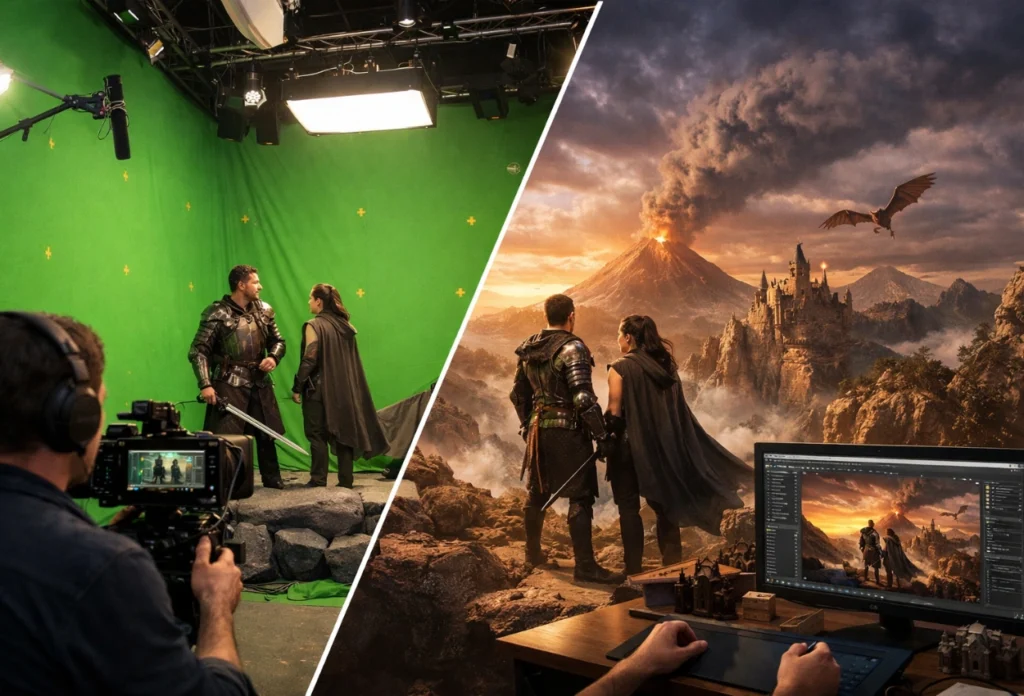

Visual effects commonly known as VFX are the invisible backbone of modern cinema. When a superhero soars through a city skyline, when a prehistoric creature charges through a jungle, when an entire planet explodes into a million pieces all of it is the work of VFX artists. But here is what most people don’t realize: the greatest visual effects work is often the work nobody notices. Replacing a dull grey sky with a dramatic sunset, erasing a safety harness from a stuntperson’s back, digitally transforming a modern street into a 1940s neighbourhood this invisible work is just as important, just as difficult, and just as skilled as the spectacular stuff. The best VFX doesn’t impress you. It simply makes you believe.
The Difference Between VFX and Practical Effects
Before diving into techniques, it helps to understand what visual effects actually are and what they are not. Practical effects are everything that happens in front of the camera, in the real world: pyrotechnic explosions, prosthetic makeup, miniature model sets, mechanical creatures, and physical stunts. Visual effects, by contrast, happen after filming is complete, in post-production, using digital software and computing power.
In modern filmmaking, the two work hand in hand. A car crash might involve a real stunt on set, with digital fire and debris added later. A creature might be built as a physical puppet for close-up interaction, then replaced with a fully CG version for wider shots. The magic lies in the seam or rather, in making that seam completely invisible.
A Brief History of Visual Effects
The story of VFX is almost as old as cinema itself. In the late 1890s, French filmmaker Georges Méliès discovered that stopping the camera mid-shot and then restarting it could make objects appear and disappear as if by magic. His stop-motion substitution trick and experiments with double exposure made him cinema’s first special effects artist and its first magician.
For decades, the craft evolved slowly through optical printing, matte paintings on glass, and intricate miniature work. Then in 1977, George Lucas founded Industrial Light & Magic specifically to create the effects for Star Wars. Spaceships, alien worlds, and laser battles were achieved through painstaking practical and optical techniques. The film redefined what cinema could look like and established VFX as a discipline worthy of serious creative investment.
The true revolution came in 1993 with Jurassic Park. For the first time, a fully computer-generated creature the T-Rex appeared so convincingly real that audiences accepted it without question. CGI had arrived, and nothing in cinema would ever be the same.
James Cameron’s Avatar in 2009 pushed the next frontier: performance capture. Every subtle expression on an actor’s face, every gesture, was translated digitally onto a computer-generated character with unprecedented fidelity. The Na’vi looked alive because real human performances lived inside them.
Today, artificial intelligence and real-time rendering are driving the next transformation but we will get to that.
The Core Techniques of Visual Effects
1. CGI Computer Generated Imagery
CGI is the foundation on which almost everything else in modern VFX is built. Using software like Autodesk Maya, Houdini, and Cinema 4D, artists construct three-dimensional objects, characters, and entire environments from scratch. The process involves multiple stages: modelling the geometry, applying surface textures and materials, setting up lighting, and finally rendering the computationally intensive process of calculating how light interacts with every surface in a scene.
A single CGI asset a spaceship, a creature, a photorealistic tree can take weeks to build and refine. A complex shot featuring multiple CG elements might take months of combined artist time. The rendering alone for major productions often requires entire server farms running continuously.
2. Compositing
If CGI is the raw material, compositing is where everything comes together. Compositing is the art of combining multiple visual layers live action footage, CGI renders, practical elements, matte paintings, colour corrections into a single seamless image. It is, in many ways, the most critical step in the entire VFX pipeline.
A skilled compositor must be part technician and part visual artist. They need to match colour, grain, depth of field, lens distortion, and light direction across elements that were created in completely different conditions. The best compositing work is entirely invisible. You never think about it which means it worked.
Industry-standard tools include Foundry’s Nuke for film-level compositing and Adobe After Effects for broadcast and smaller productions.
3. Matte Painting
Originally created by painting on large sheets of glass that were placed in front of the camera, matte paintings are background environments that extend or entirely replace what a camera could practically capture. A medieval castle on a distant hill, a vast alien skyline, a snow-covered mountain range behind an actor standing on a studio set these are the work of matte painters.
Today’s digital matte painters work primarily in Photoshop and Nuke, combining photography, 3D renders, and hand-painted elements into environments so convincing they are indistinguishable from real locations. The best matte paintings aren’t just technically accurate they have atmosphere, mood, and painterly beauty that real locations sometimes lack.
4. Green Screen and Chroma Keying
Perhaps the most widely recognised technique in VFX, chroma keying involves filming subjects against a brightly coloured, uniformly lit backdrop most commonly green, sometimes blue and then digitally removing that colour in post-production, replacing it with any background imaginable.
Green is the preferred colour because it sits furthest from natural human skin tones, making it easier to cleanly separate the subject from the background without colour contaminating the actor’s face or hands. Blue screens are used when the subject is wearing green clothing, or when the shooting environment involves a strong green light source.
Good chroma key work depends on several factors: even, shadowless lighting on the backdrop, sufficient distance between subject and screen to prevent colour spill, and careful edge work in compositing to handle hair, translucent fabrics, and fine details. A poorly executed green screen shot where a green fringe haunts the edges of the subject is immediately jarring and impossible to ignore.
5. Motion Tracking
Adding a digital element to live-action footage only works if that element moves exactly as the camera moves. Motion tracking is the process of analysing footage to determine the precise position, rotation, and movement of the camera on every single frame, so that CG elements can be locked perfectly to the scene.
Without accurate tracking, a digital spaceship sitting on a rooftop will appear to slide and float in a deeply unconvincing way. With it, the object appears to truly exist in the physical space. Tools like SynthEyes, PFTrack, and the built-in tracking in After Effects and Nuke are used to solve this problem, with artists manually refining the results to ensure precision.
6. Fluid and Particle Simulation
Fire, water, smoke, explosions, cloth, dust all of these are achieved through physics-based simulation. Artists define rules that govern how particles and volumes behave, and then the software calculates how those elements move and interact over time.
Houdini, developed by SideFX, is the dominant tool for this kind of work. Its procedural, node-based system allows artists to construct extraordinarily complex simulations a tsunami consuming a coastline, a building collapsing into rubble, a spaceship disintegrating as it falls through an atmosphere. Each element is governed by physics, which gives simulations their convincing sense of weight and consequence.
There is a crucial artistic challenge here, however. Physically accurate simulations often look wrong on screen. A real explosion, captured accurately, can appear underwhelming. A cinematic explosion must feel enormous, dangerous, and dramatic which often means art-directing the simulation away from pure physics and toward emotional truth. VFX artists are always making these kinds of judgement calls.
7. Rotoscoping
Rotoscoping is one of the oldest and most labour-intensive techniques in VFX. It involves drawing a precise outline frame by frame around a subject in footage, separating it from its background so it can be placed onto a new one, or so that effects can be applied around it.
A complex rotoscope task might involve carefully tracing every strand of an actor’s hair, every moving finger, across hundreds or thousands of individual frames. It is painstaking, detailed work that demands both patience and a sharp eye. AI-assisted tools like Adobe’s Roto Brush and Runway’s automated rotoscoping have significantly accelerated this process, though experienced artists still review and correct the results carefully.
The LED Volume: Beyond the Green Screen
One of the most significant developments in recent VFX history is the rise of virtual production on LED volumes. Rather than placing actors in front of a green screen, productions now surround them with enormous curved walls of high-resolution LED panels, displaying photorealistic, real-time rendered environments from game engines like Unreal Engine 5.
The camera sees a seamless world. The actors can see and react to their environment. Most importantly, the screen emits real, coloured light meaning actors are naturally lit by the environment they appear to be standing in, solving the perennial lighting mismatch problem that haunted green screen work for decades.
Disney’s The Mandalorian brought this technology to mainstream attention and proved it could work at scale. Productions including The Batman, 1899, and Thor: Love and Thunder have since adopted it. The LED volume doesn’t replace all other techniques but for certain kinds of work, it is a transformative improvement.
Artificial Intelligence and the Future of VFX
The VFX industry is in the middle of another significant shift, driven by machine learning and artificial intelligence. Tasks that once required weeks of skilled manual labour are being accelerated dramatically. Automated rotoscoping, background removal, object tracking, face replacement, and de-aging the kind of work used to make Robert De Niro appear decades younger in The Irishman are all being assisted by AI tools.
This does not mean VFX artists are being replaced. What it means is that the nature of the work is changing. Repetitive, time-consuming tasks that once consumed enormous amounts of artist hours are being handled faster, freeing creative professionals to spend more time on the work that genuinely requires human judgement, taste, and artistry. AI handles the mechanical; humans handle the meaningful.
The other major frontier is real-time rendering. Unreal Engine 5’s Nanite and Lumen systems can generate photorealistic scenes at interactive speeds something that would have seemed impossible just five years ago. This is making virtual production faster, cheaper, and more flexible, and it is beginning to close the gap between what major studios and independent filmmakers can achieve.
Visual Effects Are Storytelling
At its core, visual effects has never been a purely technical discipline. Every destroyed city, every impossible creature, every seamless sky replacement exists in service of a story to put an audience somewhere they could never physically go, to make them feel something they could never otherwise experience.
The greatest VFX supervisors will tell you the same thing: the best visual effect is the one nobody notices. The technique exists to serve the narrative, not to advertise itself. When a shot is working truly working the audience is thinking about the character, the emotion, the stakes. They are not thinking about how it was made.
As the tools of visual effects become more powerful and more accessible, the art form is expanding beyond the walls of major studios. Independent filmmakers, small teams, even individual artists can now create work that would have required a Hollywood budget just a decade ago. The discipline of making the impossible look real belongs to anyone willing to learn it and that, perhaps, is the most exciting development of all.